Sylvaine Abelan–Jaromir
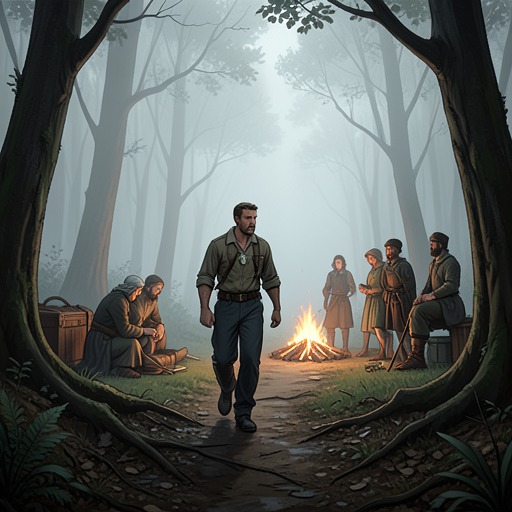
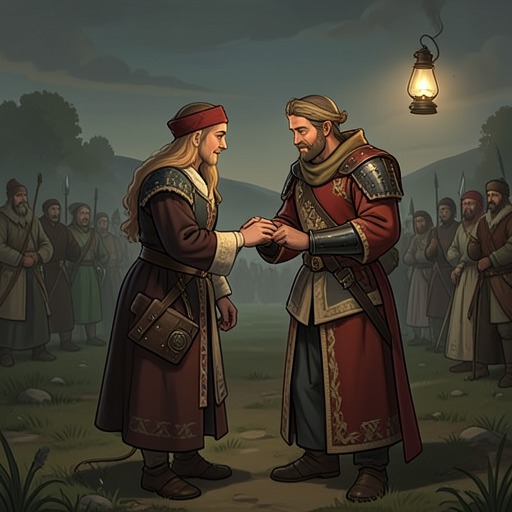
The Ballad of the Last DragonSylvaine Abelan–Jaromir begins as an antagonistic connection within the traveling company and develops through a repeated pattern of provocation, rejection, protection, and sudden physical disclosure. Jaromir treats Sylvaine as an unwanted complication, while Sylvaine answers his hostility with artistic pride and deliberate needling; beneath that conflict, however, their bodies and attention repeatedly betray an attraction neither handles directly. The relationship’s decisive movement is from public resistance to private vulnerability, culminating in Jaromir’s kiss and Sylvaine’s later demand to understand why he withdraws after their encounter by the river.
First Encounter and Mutual Resistance
Sylvaine first experiences Jaromir as an intimidating presence whose deep, gravel-edged voice and towering frame make his refusal feel physically imposing. When she sings louder to force him to acknowledge her and he abruptly rises, scraping his chair across the tavern floor, her instinct is not submission but imagined retaliation: she wants to knock him over simply to discover how hard he would fall. His rejection wounds her, yet she converts the wound into an artist’s professional discipline, telling herself that performers must bleed for the masses while thickening their skin.
Their earliest exchanges establish a conflict over whether Sylvaine belongs with the company. When Jaromir drops a satchel containing what sounds like pots and pans at the group’s feet, he states that she should not be coming. Sylvaine interprets the objection as personal hostility and wonders whether he has noticed her ears and joined those who distrust Elves. Instead of asking him plainly, she needles him about his habit of throwing things, turning his practical resistance into an accusation of immaturity. The exchange gives their antagonism a distinctive form: Jaromir attempts to exclude her through blunt action, while Sylvaine protects herself through wit and performance.
Conflict on the Road
The disagreement becomes more explicit when Aeron Fowler argues that the company cannot make history if nobody knows about it, and Sylvaine insists that she should decide when and where their stories are told. Jaromir turns on her, advancing with an agitated and aggressive gait, and declares that she is the last thing the group needs and should not even be there. Sylvaine regards this as another reduction of her worth to a burden, especially because she believes she has already proved herself repeatedly. She tries to dismiss him as insignificant, but her reply reveals how much his judgment matters: even her attempt to ignore him becomes an argument with him.
Jaromir’s response complicates the hostility. He claims responsibility for keeping her on her feet rather than face down in the dirt, recasting his severity as protection. The remark does not resolve the conflict, because protection offered without tenderness can resemble control or contempt, but it exposes an important structure in the relationship. Jaromir’s attention to Sylvaine is not indifference. He watches her safety closely, yet expresses concern through reprimand and exclusion, while Sylvaine receives that concern as an insult until the danger behind it becomes impossible to overlook.
Attraction and the River Encounter
The relationship shifts when physical proximity strips away the safety of their verbal sparring. Jaromir moves quickly while Sylvaine is backed against a tree, with her notebook the only barrier between their chests. He crouches to meet her at eye level, his dark eyes moving over her face with undisguised intent, and tells her that nothing else happened the previous night. His breath brushes her lips, and Sylvaine struggles not to lean closer even as she insists that she does not care. The scene makes their attraction bodily before either character can organize it into a candid confession: breath, distance, posture, and the notebook all become part of a negotiation neither can keep purely verbal.
Sylvaine then tests his explanation by asking why, if anyone would do, he did not ask her. The challenge briefly restores her control, but it also exposes the personal stakes beneath her teasing. Jaromir’s shock and retreat give her enough distance to think, yet the reversal lasts only a moment. He tips up her chin and kisses her before she can finish reacting. The kiss is therefore both a surrender and an interruption: it answers her provocation through action while refusing the safer language of explanation. Their antagonism does not disappear; it changes register, becoming the charged surface of an intimacy neither is prepared to name.
Secrecy, Withdrawal, and Emotional Development
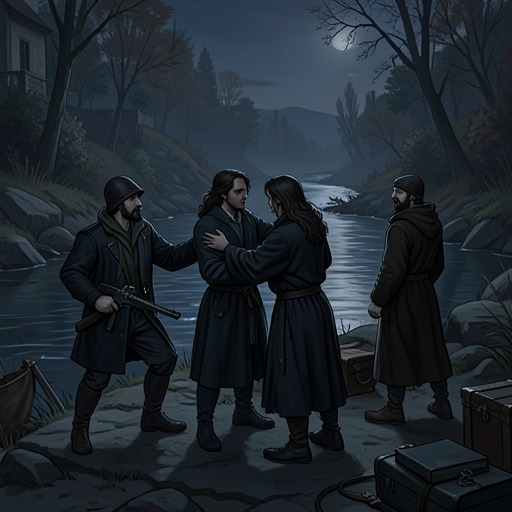
After what happened by the river, Sylvaine confronts Jaromir about his apparent determination to have nothing to do with her. Her question places the relationship’s central problem in plain terms: physical closeness has occurred, but public acknowledgment has not followed. Jaromir stiffens and explains that he did not think she wanted everyone to know her business, with Aeron Fowler evidently included in the group of people from whom he is protecting their privacy. His withdrawal is thus presented not as proof that the kiss meant nothing, but as a guarded response to the social consequences of intimacy.
The exchange also reveals the unequal ways they manage vulnerability. Sylvaine approaches through direct challenge, irony, and insistence on her own agency; Jaromir retreats into silence, protective discretion, and controlled bodily presence. She is willing to risk embarrassment to obtain an answer, whereas he treats concealment as consideration. That mismatch sustains the relationship’s tension. Jaromir’s care can look like rejection, and Sylvaine’s pursuit of clarity can look to him like exposure, yet both are responding to the same newly dangerous attachment.
Narrative Significance
Sylvaine Abelan–Jaromir is built around the collision of two forms of resistance. Sylvaine refuses to be made small by Jaromir, by the company’s doubts, or by anti-Elven suspicion; Jaromir refuses to admit emotional need even while acting as though Sylvaine’s safety and presence are his responsibility. Their scenes repeatedly turn an apparent contest of dominance into evidence of mutual attention. The more harshly Jaromir tries to deny her place, the more visibly he remains oriented toward her; the more casually Sylvaine claims not to care, the more precisely she tracks his reactions.
The relationship also gives physical gestures a narrative function that dialogue cannot fulfill. A scraped chair, a dropped satchel, an aggressive advance, a notebook held between bodies, a chin lifted by the hand, and a kiss all mark stages in the movement from exclusion to contact. The result is not a settled romance within the supplied episodes but an unmistakable emotional development: hostility has become attraction, attraction has produced secrecy, and secrecy has forced Sylvaine to demand an account of what Jaromir wants and what he fears others will see.